Namibia tour highlights
From the deepest crimson red of Sossusvlei’s dunes to the wide blue skies over the country’s game-rich national parks, Namibia is a vibrant palette of color.
Explore Worldwide's Namibia adventure tours will take you through Namibia's unique scenery: the ancient sand landscapes of the Namib Desert, the colonial towns of the coast and the wide savannahs of the national parks. Here are some of our top highlights of Namibia:
Sossusvlei
Sossusvlei’s burnished sand dunes are some of the highest and most spectacular in the world, with some reaching up to 980 feet tall – Sossusvlei’s tallest sand dune is affectionately known as 'Big Daddy'. Photographers will relish an early morning visit to photograph the dunes in the first rays of sunlight, as they glow a deep orange, or visit during sunset when the light changes to a scorched red. Very little water makes its way here from the Tsauchab River valley, so the vegetation is sparse, but you may still be able to spot springbok and ostriches. On our Namibia Lodge Safari, our day in Sossusvlei will include a walk through the picturesque Sesriem Canyon, where pools of water attract a variety of birds and animals.
Etosha National Park
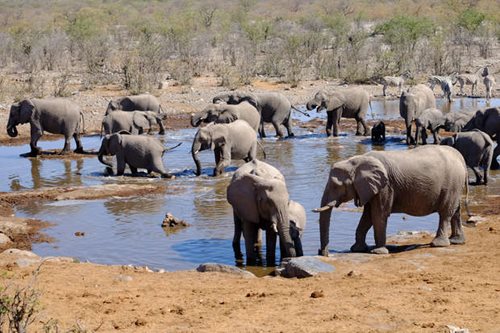
Considered one of Africa’s finest safari reserves, Etosha National Park is home to four of the Big Five African animals, though buffalo can be found elsewhere in Namibia at Waterberg Plateau. Etosha's arid habitats means make it a particularly excellent destination for viewing animals that come to drink at the waterholes. Namibia's dry winter months (June to August) are ideal for spotting rhinos, elephants and springbok. On Explore Worldwide's Namibia Safari tour, you’ll get to stay in a safari lodge just a short distance from the park.
Namib Desert
The Namib Desert is the oldest desert in the world, believed to date as far as 80 million years. It stretches from Angola in the north, along the entire coastline of Namibia and down to South Africa, with endless dunes and wide, flat salt pans that, despite the harsh environment, support a variety of species from zebras to hardy beetles. Some of Namibia’s most unusual landscapes can be found in the Namib Desert, from the plunging inhospitable dunes of the Skeleton Coast to the white clay pan of Deadvlei, set among the dunes of Sossusvlei. The Namib is a great place for spotting some of Namibia’s desert-adapted wildlife, which is largely free-roaming. This includes Hartmann’s mountain zebras, black-backed jackals, cheetahs and elephants. We visit the Namib Desert on our Lodge Safari tour, or if you have more time to explore Africa check out our Namibia Lodge Safari + South Africa Garden Route tour.
Torra Conservancy
Rugged, remote and vast, the Torra Conservancy is one of the largest of its kind in northern Namibia. On our Upgraded - Highlights of Namibia tour, venture into the reserve by 4x4 vehicle, before joining a local conservationist. They'll lead you in the footsteps of the endangered black rhinos that roam freely in this stunning landscape. This walking safari offers a much more intimate and once-in-a-lifetime experience, as we follow a lesser-visited route. This gives you ample opportunity to spot other wildlife in the area, including kudu (large woodland antelope), mountain zebras, oryx and giraffes.
Solo Travel in Namibia
Every one of our Namibia vacations is suitable for solo travelers – in fact, you can expect around half of the group on each departure will be traveling solo. The exact number of solo travelers varies depending on which tour you choose, but you'll be in good company. Our small group trips to Namibia are a great opportunity to meet like-minded people and share experiences along the way.
Best time to go to Namibia
The most popular time to visit Namibia is June to October when the temperatures are a bit cooler and the days are dry and bright. This dry season is also the best time to spot wildlife gathering around the waterholes of Etosha National Park.
If you want to escape the crowds, head to Namibia in February and March, the 'green season'. It will feel hotter and more humid, with some rain, but you’ll be rewarded with sightings of migratory birds and lush countryside.
April is the shoulder season when temperatures start to drop, and rain becomes less frequent, while the landscape stays green. It's the perfect choice for an Easter getaway.